
Concrete Driveways Built for Calgary’s Freeze-Thaw
A new concrete driveway in Calgary runs $12–$20 per square foot installed, depending on the finish. The difference between one that lasts 30 years and one scaling by year five is not price — it is the mix, the rebar, and the base you never see after pour day.
Patriarch Construction has poured Calgary driveways across four generations. Driveways are the hardest-working concrete on your property: they carry vehicle loads, take 40-plus freeze-thaw cycles a winter, and sit on the expansive clay that moves under half this city. Cut a corner on any one input and it shows up in three to five years as scaling, cracking, or heaving at the garage apron.
Here is what we install, what it costs, and the questions to ask before you sign anyone’s quote.
What we pour, as standard
Before you sign, make a contractor answer three things directly: the MPa strength and air content of the mix, the reinforcement they use, and how deep the base prep goes. A contractor who deflects on any of those is telling you where they cut cost.
Concrete driveway cost in Calgary (2026)
Most Calgary contractors won’t give a number without a sales call. Here are the actual installed ranges by finish.
| Finish | Installed cost | Best for |
|---|---|---|
| Brushed (broom) | $12–14 | The economical workhorse — proven grip and durability for Calgary winters. |
| Exposed aggregate | $16–18 | Calgary’s most popular finish — grippy, hides salt and tire marks, very durable. |
| Stamped | $18–20 | Premium decorative look (stone, slate, brick); needs a non-slip additive for winter. |
| Breakout & haul away | +$4–6 | Add-on to remove and dispose of an existing driveway before the new pour. |
What the price includes
Site prep, gravel sub-base, forming, rebar/mesh reinforcement, the 32 MPa air-entrained pour, finishing, control joints, and clean-up. Sealer is optional and quoted separately.
What changes the price
Existing concrete removal, slope corrections, drainage work, slab thickness above 4″, curves and decorative borders, and access (front-yard vs. back-yard pumping).
Choosing a finish
Three finishes make sense on a Calgary driveway. Each handles winter differently.
Brushed
$12–14 /sq ftThe standard broom finish. Light texture for traction, the lowest cost, and a clean, consistent look. The sensible default for most driveways.
Exposed aggregate
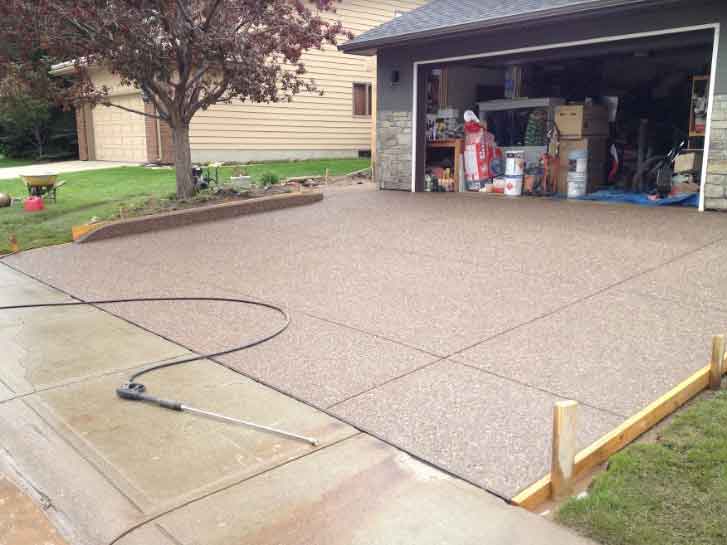
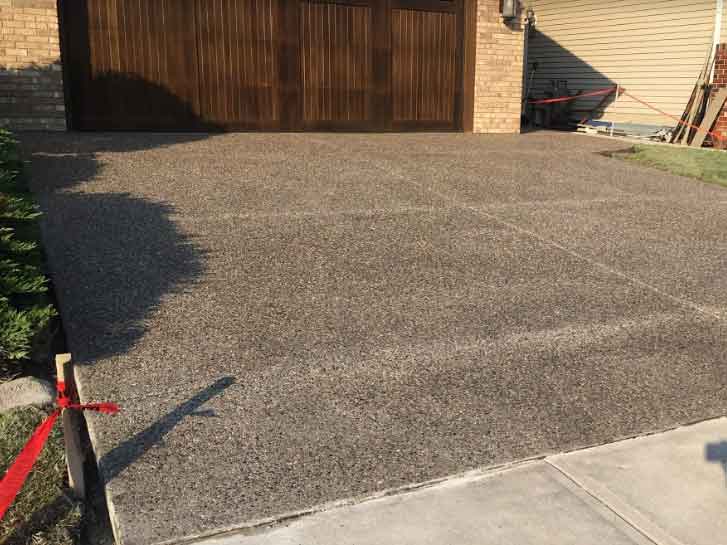
$16–18 /sq ftWashed to reveal the stone. The texture grips in winter, the stone outlasts smooth paste, and it hides salt and tire marks. Reseal every 2–3 years. Exposed aggregate →
Stamped
$18–20 /sq ftStamped to mimic stone, slate or brick. The premium look, with a non-slip additive added to the sealer so it stays safe on ice. Stamped patterns →
Pouring a garage pad at the same time? We price it as one combined project — same crew, same day, one mobilisation instead of two.
Concrete vs. asphalt in Calgary
Concrete
Higher up front, but poured once. No two-year resealing cycle, lasts decades through freeze-thaw, and buyers prefer it — nobody wants to redo a driveway right after closing.
Asphalt
Roughly half the install cost, but needs resealing every couple of years and wears faster under Calgary winters. The gap closes fast once you count 25 years of upkeep.
Done right, a concrete driveway outlasts two asphalt ones and costs less over its life once resealing and replacement are counted.
How the install works
A typical driveway replacement runs 3–4 days, weather permitting.
Demo & excavate
Break out and haul away the old driveway, then excavate soft soil to a stable subgrade.
Base, forms & rebar
Compacted road-crush base, formed edges, and a 10M rebar grid set on chairs.
Pour & finish
Fresh 32 MPa air-entrained mix, finished to your chosen texture, control joints cut.
Cure
Walk on at 24 hours. Keep vehicles off 7–28 days depending on mix and weather.
Repair or replace?
Not every cracked driveway needs tearing out. Hairline cracks under ¼″ or minor surface spalling can often be repaired or sealed to buy years. But deep structural cracks, sections heaving by inches, or sinking at the garage apron usually mean replacement — on Calgary’s clay, patching a heaving slab just cracks again within a year.
We give an honest on-site read, not the bigger invoice. Breakout & haul away →
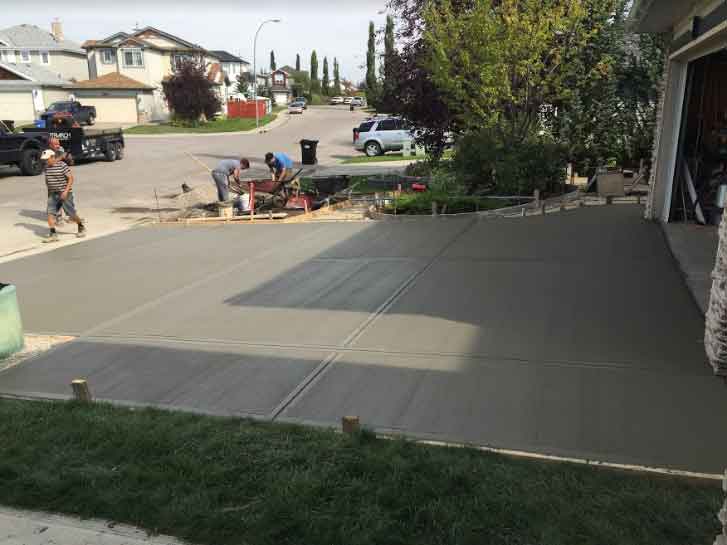
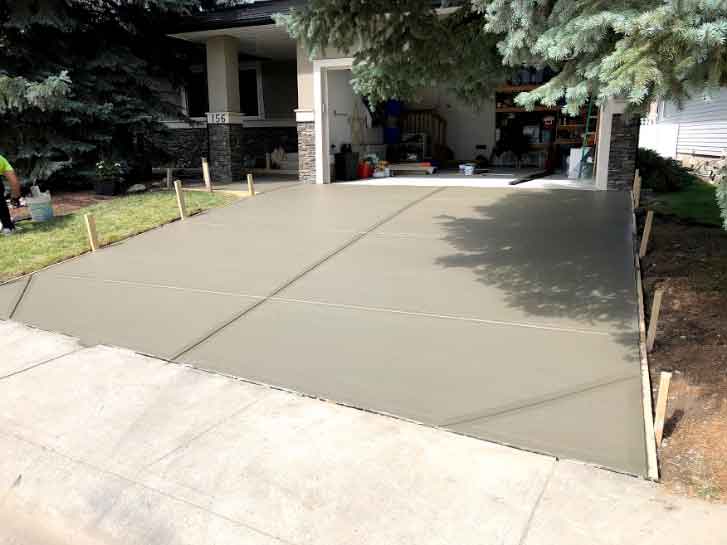
Recent Calgary driveways
Completed installs across Calgary and area.




Concrete driveway FAQ
How much does a new concrete driveway cost in Calgary?
Installed cost runs about $12–$20 per square foot depending on finish: brushed $12–14, exposed aggregate $16–18, and stamped $18–20. Removing an existing driveway adds $4–6 per square foot for breakout, hauling and disposal. Call (403) 862-0449 for a free, written, line-item quote.
Which driveway finish is best for Calgary winters?
Exposed aggregate is the top performer. The textured pebble surface grips through freeze-thaw where smooth finishes get slick, the stone resists wear from tires and shovels, and it hides salt and tire marks. Brushed is a close, cheaper second. Stamped needs a non-slip additive in the sealer to be safe on ice.
My driveway is cracking — repair or replace?
Hairline cracks under a quarter inch or minor surface spalling can often be repaired or sealed. Deep structural cracks, heaving by inches, or sinking at the garage apron usually mean replacement — on Calgary clay, patching a heaving slab cracks again within a year. We assess on site for free and give the honest call.
What specs do you use to prevent cracking and heaving?
A compacted road-crush sub-base over excavated subgrade for drainage and stability; a 10M rebar grid rather than wire mesh; a 32 MPa air-entrained mix built for exterior freeze-thaw; and control joints cut at 8–10 ft to manage movement. Those four are the difference between a 30-year driveway and a five-year one.
How long does installation take?
About 3–4 days, weather permitting: demolition and excavation, then base/forming/rebar, then pour and finish. You can walk on it at 24 hours; keep vehicles off for 7–28 days depending on mix and weather.
Do I need to seal my concrete driveway?
Yes. Unsealed concrete absorbs water that freezes, expands, and scales the surface. Sealing also resists salt and oil. Exposed aggregate should be resealed every 2–3 years; brushed and stamped should be sealed too. We handle install and maintenance sealing.
Serving Calgary & area
Based in NW Calgary, pouring driveways anywhere within roughly 50 km — including Airdrie, Cochrane, Chestermere and Okotoks.
Driveways by community
Get a real number, not a sales pitch
Free on-site assessment, a written line-item quote, and a driveway built to outlast the one it replaces. Four generations of Calgary concrete.
 SEO - MRC SEO Consulting